

Co-Founders of ATRX Research Alliance
By Jennifer Martinez and Ben Harris | Co-Founders, ATRX Research Alliance
Five years ago, we began a journey that would change our lives in ways we never could have imagined.
As parents of Benjamin and Gabriel, who both have ATR-X syndrome, we know firsthand what it means to live with an ultra-rare genetic condition. We know the uncertainty, the challenges, and the desire to give our children every possible opportunity for a better future.
In 2021, we founded what is now the ATRX Research Alliance (ARA), formerly CureATRX, because we believed families could play an important role in driving research forward.
We didn’t know exactly what the road ahead would look like. But we believed that if we could bring people together, build relationships with researchers, and create opportunities for scientific progress, we could help make a difference.
Today, five years later, we want to reflect on what has become possible and thank the people who helped us get here.
To our family, friends, early donors, and supporters: before anything else, thank you.
Many of you know us personally or professionally. You’ve watched our family grow, followed our journey with Benjamin and Gabriel, and supported this mission in ways we will never forget.
The progress we’re sharing today exists in part because you believed in us, even when the path forward was uncertain.

Brothers Benjamin and Gabriel, whose ATR-X diagnoses inspired their parents to establish ATRX Research Alliance in 2021.
Quiet Miles, Real Progress
Much of the work of building a research-focused organization happens quietly, behind the scenes.
Over the past five years, our leadership team, made up entirely of parents of children with ATR-X syndrome, has worked to build relationships, strengthen scientific collaborations, and create opportunities for meaningful research.
At the same time, we’ve continued navigating the everyday realities of raising children with complex medical and developmental needs.
As our children grow, new challenges emerge. Across our community, families are navigating seizures, gastrointestinal issues, mobility changes, behavioral challenges, and safety concerns, among many other difficulties.
We continue learning how to support our children and one another.
And through it all, hope remains at the center of what we do.
This work is deeply personal. Every research conversation, every scientific collaboration, and every opportunity to move the science forward represents the possibility of a better future for our children and others living with ATR-X syndrome.
What You’ve Helped Make Possible
We are proud of the foundation our community has helped build since 2021.
With the support of families, donors, researchers, and partners, ARA has helped advance several important initiatives.
Building research resources
We’ve supported early-stage drug discovery efforts, including work involving induced pluripotent stem cell (iPSC) models. These models allow researchers to study ATR-X syndrome and explore potential therapeutic approaches.
We’ve also worked to expand patient participation in research through registry enrollment, medical record sharing, and biosample collection.
These resources are essential to helping researchers better understand ATR-X syndrome and creating opportunities for future studies.
Moving gene therapy research forward
One of the developments we’re most encouraged by is the collaboration between Dr. Allison Bradbury of Nationwide Children’s Hospital and Dr. David Picketts of Ottawa Hospital Research Institute.
ARA helped bring these researchers together to explore a potential gene therapy approach for ATR-X syndrome.
Their dual-vector gene therapy program is now in preclinical development, with work underway on improved mouse models and a growing mouse colony to support the research.
The researchers have continued advancing this work using smaller funding opportunities and institutional resources.
Their dedication to an ultra-rare condition like ATR-X syndrome is extraordinary, and we’re deeply grateful for their commitment.
While significant research and funding needs remain, this is meaningful progress toward exploring a potential therapeutic option for our community.

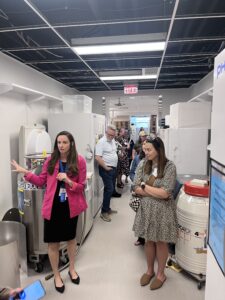

Bringing scientists and families together to advance understanding of ATR-X syndrome.
Growing scientific interest and collaboration
We’re also encouraged to see additional researchers dedicating their expertise to ATR-X syndrome.
Dr. Rebekah Tillotson has established a laboratory dedicated to ATR-X research at the University of Edinburgh and joined ARA’s Scientific Advisory Board.
We’re also grateful for the involvement of emerging scientists, including Jack Seminetta, a PhD student contributing to ATR-X research.
Building a strong and engaged scientific community is an important part of creating lasting research momentum.
One Room, One Community

Families and researchers gathered in Columbus, Ohio, for ARA’s inaugural Scientific and Family Conference in April 2026.
In April 2026, we celebrated another major milestone: ARA’s first in-person Scientific and Family Conference in Columbus, Ohio.
For us, this was especially meaningful.
Families who had connected from across the world had the opportunity to meet, share experiences, and engage directly with the scientists working to better understand ATR-X syndrome.
Researchers were able to hear firsthand about the challenges families face and the questions that matter most to our community.
Seeing everyone together was a powerful reminder of why we began this work.
It was also a moment to recognize just how far we’ve come.
To everyone who supported ARA and helped make this gathering possible, thank you. You helped create an opportunity for connection, collaboration, and shared purpose that will continue to influence our work.
Progress Is Real, and Momentum Is Building
Five years ago, we hoped we could help make ATR-X syndrome a greater research priority.
Today, scientific collaborations are established, important research resources are growing, and a potential gene therapy approach is being investigated in the laboratory.
There is still a great deal of work ahead.
The preclinical phase of the gene therapy research program is not yet fully funded, and advancing research for an ultra-rare condition requires sustained financial support, scientific expertise, and collaboration.
As parents, we understand the urgency.
We want therapeutic options that could improve the lives of our children and others living with ATR-X syndrome today, not only for future generations.
Waiting is hard.
But we also recognize that the progress we’ve helped make possible over the past five years has created a foundation for what comes next.
We are no longer simply imagining what might be possible. We are actively working toward making it a reality.
From Our Family to Yours, Thank You
We wanted to share this reflection because so many people have played a part in our journey.
Some of you supported us when ARA was little more than an idea. Others have joined us along the way, offering encouragement, expertise, financial support, or connections that helped open new doors.
Every contribution has mattered.
What began as a deeply personal mission for our family has grown into something much larger: a community working together to advance research and create more possibilities for individuals living with ATR-X syndrome.
We are proud of what we’ve accomplished, grateful for the people who have walked alongside us, and hopeful about what lies ahead.
To everyone who has believed in our family and this mission, thank you.
Your support has helped build a more hopeful future for Benjamin, Gabriel, and every individual living with ATR-X syndrome.
With heartfelt gratitude,
Jennifer Martinez and Ben Harris
Co-Founders, ATRX Research Alliance
Faith | Hope | Urgency
Stay Connected
Five years of progress have brought us to an exciting point in ATR-X research, but there’s still much work ahead.
We invite you to stay connected as we share research developments, introduce the scientists helping move this work forward, and highlight opportunities to support and participate in our mission.
Subscribe to ARA’s NewsletterYou can also read Jennifer’s reflection on five years of ATR-X research progress or explore more about our mission at ATRX Research Alliance.
Thank you for being part of this journey.
Recent Comments